
Sub-Total: $0.00
Essential Nutrients for Prostate Tissue Success
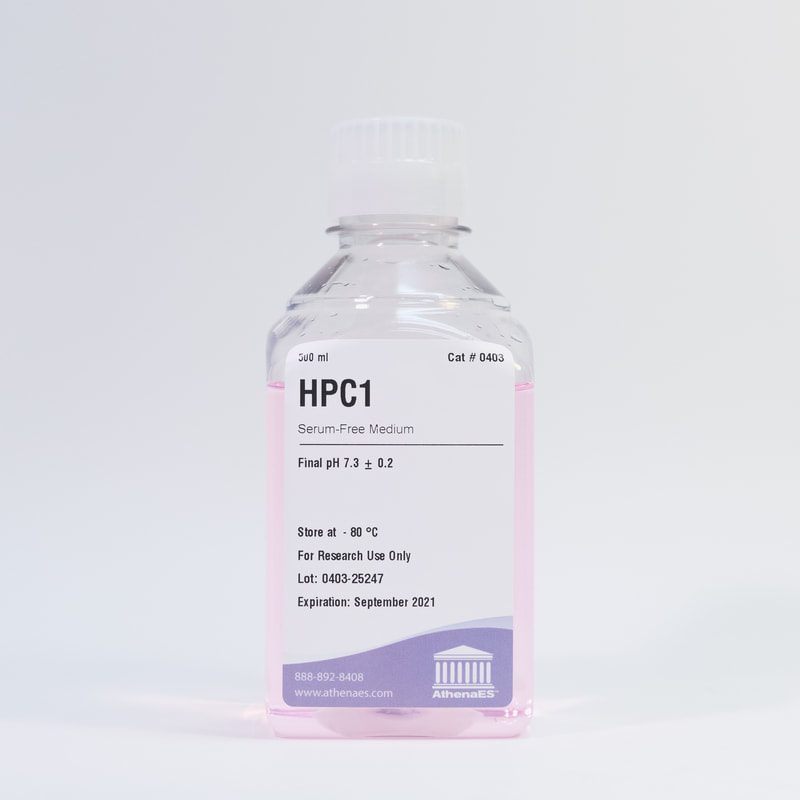
BRFF-HPC-1™ is a complete serum-free medium comprised of essential amino acids, vitamins, inorganic salts, trace elements, growth factors, and dihydrotestosterone, designed for establishing new cell lines from human prostate tissue. HPC-1™ was developed and has been extensively used for establishing and maintaining epithelial cell lines from both benign prostatic hyperplasia and prostatic carcinoma. Optimal attached monolayer cell growth can be achieved when used in conjunction with FNC Coating Mix®.
| Order # | Product Name | Type | Unit | Price |
|---|---|---|---|---|
| 0403 | BRFF-HPC1™ | Liquid (ready-to-use) | 500mL | $124.30 |
Product Specifications
| Storage | Store at -80°C, supplied frozen |
| Stability at 4 ̊C | 4 - 6 weeks |
| pH | 7.3 ± 2 |
| Osmolality | 270 - 300mOsM |
References:
Cunningham ML, Jasibel Vasquez‐Gonzalez, Barnada SM, et al. PARP inhibitors elicit distinct transcriptional programs in homologous recombination competent castration‐resistant prostate cancer. Molecular Oncology. Published online September 7, 2025. doi:https://doi.org/10.1002/1878-0261.70098
Snyder LB, Neklesa TK, Willard RR, Gordon DA, Pizzano J, Vitale N, Robling K, Dorso MA, Moghrabi W, Landrette S, Gedrich R, Lee SH, Taylor ICA, Houston JG. Preclinical Evaluation of Bavdegalutamide (ARV-110), a Novel PROteolysis TArgeting Chimera Androgen Receptor Degrader. Mol Cancer Ther. 2025 Apr 2;24(4):511-522. doi: https://doi.org/10.1158/1535-7163.MCT-23-0655. PMID: 39670468; PMCID: PMC11962395.
Cheng CJ, Ye X, Funda Vakar-Lopez, et al. Bone Microenvironment and Androgen Status Modulate Subcellular Localization of ErbB3 in Prostate Cancer Cells. Molecular Cancer Research. 2007;5(7):675-684. doi:https://doi.org/10.1158/1541-7786.mcr-06-0306
Shiina, M., Hashimoto, Y., Kulkarni, P. et al. Role of miR-182/PDCD4 axis in aggressive behavior of prostate cancer in the African Americans. BMC Cancer 21, 1028 (2021). https://doi.org/10.1186/s12885-021-08723-6
Ifere Go, Desmond R, Demark-Wahnefried W, Nagy Tr. Apolipoprotein E gene polymorphism influences aggressive behavior in prostate cancer cells by deregulating cholesterol homeostasis. International Journal of Oncology. 2013;43(4):1002-1010. doi:https://doi.org/10.3892/ijo.2013.2057
Kaushik AK, Vareed SK, Basu S, et al. Metabolomic Profiling Identifies Biochemical Pathways Associated with Castration-Resistant Prostate Cancer. Journal of Proteome Research. 2013;13(2):1088-1100. doi:https://doi.org/10.1021/pr401106h
Wan X, Liu J, Lu JF, et al. Activation of β-Catenin Signaling in Androgen Receptor–Negative Prostate Cancer Cells. Clinical Cancer Research. 2012;18(3):726-736. doi: https://doi.org/10.1158/1078-0432.ccr-11-2521
YANG P, CARTWRIGHT CA, LI J, et al. Arachidonic acid metabolism in human prostate cancer. International Journal of Oncology. 2012;41(4):1495-1503. doi:https://doi.org/10.3892/ijo.2012.1588
Saini S, Majid S, Yamamura S, et al. Regulatory Role of mir-203 in Prostate Cancer Progression and Metastasis. Clinical Cancer Research: An Official Journal of the American Association for Cancer Research. 2011;17(16):5287-5298. doi:https://doi.org/10.1158/1078-0432.CCR-10-2619
Lai J, Lehman ML, Dinger ME, et al. A variant of the KLK4 gene is expressed as a cis sense–antisense chimeric transcript in prostate cancer cells. RNA. 2010;16(6):1156-1166. doi:https://doi.org/10.1261/rna.2019810
Gueron G, De Siervi A, Ferrando M, et al. Critical Role of Endogenous Heme Oxygenase 1 as a Tuner of the Invasive Potential of Prostate Cancer Cells. Molecular Cancer Research. 2009;7(11):1745-1755. doi:https://doi.org/10.1158/1541-7786.mcr-08-0325
Lai J, Myers SA, Lawrence MG, Odorico DM, Clements JA. Direct Progesterone Receptor and Indirect Androgen Receptor Interactions with the Kallikrein-Related Peptidase 4 Gene Promoter in Breast and Prostate Cancer. Molecular Cancer Research. 2009;7(1):129-141. doi:https://doi.org/10.1158/1541-7786.mcr-08-0218
Dimitroff CJ, Descheny L, Trujillo N, et al. Identification of Leukocyte E-Selectin Ligands, P-Selectin Glycoprotein Ligand-1 and E-Selectin Ligand-1, on Human Metastatic Prostate Tumor Cells. Cancer Research. 2005;65(13):5750-5760. doi:https://doi.org/10.1158/0008-5472.can-04-4653
Zhu H, Mazor M, Kawano Y, et al. Analysis of Wnt Gene Expression in Prostate Cancer: Mutual Inhibition by WNT11 and the Androgen Receptor. Cancer Res. 2004;64(21):7918-7926. https://doi.org/10.1002/1878-0261.70098
Fizazi K, Sikes CR, Kim J, et al. High efficacy of docetaxel with and without androgen deprivation and estramustine in preclinical models of advanced prostate cancer. Anticancer research. 2004;24(5A):2897-2903. https://pubmed.ncbi.nlm.nih.gov/15517894/
Dimitroff CJ, Lechpammer M, Long-Woodward D, Kutok JL. Rolling of Human Bone-Metastatic Prostate Tumor Cells on Human Bone Marrow Endothelium under Shear Flow Is Mediated by E-Selectin. Cancer Research. 2004;64(15):5261-5269. doi:https://doi.org/10.1158/0008-5472.can-04-0691
Jung C, Kim RS, Lee SJ, Wang C, Jeng MH. HOXB13 Homeodomain Protein Suppresses the Growth of Prostate Cancer Cells by the Negative Regulation of T-Cell Factor 4. Cancer Research. 2004;64(9):3046-3051. doi:https://doi.org/10.1158/0008-5472.can-03-2614
van Bokhoven A, Varella-Garcia M, Korch C, et al. Molecular characterization of human prostate carcinoma cell lines. The Prostate. 2003;57(3):205-225. doi:https://doi.org/10.1002/pros.10290
Navone NM, Olive M, Ozen M, et al. Establishment of two human prostate cancer cell lines derived from a single bone metastasis. Clinical cancer research : an official journal of the American Association for Cancer Research. 1997;3(12 Pt 1):2493-2500. https://pubmed.ncbi.nlm.nih.gov/9815652/